Supreme Court Ruling Empowers Trump to Slash Federal Workforce
Hundreds of Thousands of Jobs at Risk as ‘Reductions in Force’ Resume
In a dramatic move that could reshape the structure of the U.S. government, the Supreme Court has paved the way for former President Donald Trump’s administration to proceed with sweeping layoffs of federal employees. This ruling reverses a prior lower court decision and significantly strengthens Trump’s hand in his efforts to “deconstruct the administrative state”—a long-held conservative goal.
A Major Win for Trump’s Anti-Bureaucracy Agenda
The Supreme Court’s decision to lift a freeze on the Trump administration’s proposed “reductions in force” (RIFs) marks another major legal victory for the former president in his ongoing second-term push to shrink the federal bureaucracy.
With litigation over the scope of the executive’s authority still ongoing, the Court’s ruling means that layoffs across multiple departments—ranging from Health and Human Services to the Department of Veterans Affairs—can begin immediately.
Critics warn this could result in “catastrophic disruption” of essential public services and undermine the neutrality and continuity of the civil service. But for Trump’s political base, the move is being heralded as a long-overdue reckoning with what they perceive as a bloated, unaccountable “deep state.”
The Ruling: A Sharp Legal Reversal
The decision overturns a May 22 ruling by U.S. District Judge Susan Illston in San Francisco. Illston had blocked the layoffs, asserting that the president could not unilaterally reorganize or dismantle federal agencies without explicit authorization from Congress.
In her ruling, Illston wrote:
“The president may broadly restructure federal agencies only when authorized by Congress.”
But the Supreme Court, without issuing a full opinion, stayed her order. This effectively sides with the Trump administration’s argument that it has the constitutional authority to direct the executive branch and remove personnel deemed unnecessary or disloyal.
Legal analysts say the ruling could have implications far beyond the current administration, potentially redefining presidential authority over the federal workforce for decades to come.
Departments on the Chopping Block
The agencies most vulnerable to imminent layoffs include:
-
Department of Agriculture
-
Department of Commerce
-
Department of Health and Human Services
-
Department of State
-
Department of the Treasury
-
Department of Veterans Affairs
According to internal memos leaked last month, “non-essential” and “non-loyal” employees are at the top of the list for potential dismissal. While the administration has not clarified what “non-loyal” means in this context, watchdog groups fear it could be a euphemism for political purging of civil servants.
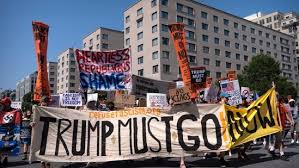
With hundreds of thousands of jobs at stake, labor unions representing federal workers are preparing legal challenges and protests.
What’s Driving the Push?
Trump’s efforts to centralize control over federal agencies date back to his first term, particularly under initiatives like “Schedule F,” which aimed to reclassify thousands of civil servants as at-will employees.
While that effort was blocked under President Biden, Trump revived the plan upon returning to office and framed it as a way to “drain the swamp” of bureaucrats obstructing his policy goals.
Now, with the Supreme Court’s backing, he has an open path to restructure government from the inside out.
Critics: A Constitutional Crisis in the Making?
Constitutional scholars and former federal officials have expressed alarm.
Harvard Law professor Laurence Tribe called the ruling “deeply dangerous,” warning that it effectively grants the president unilateral power over the government’s day-to-day operations without congressional checks.
“Congress created these agencies. For the Court to now say the president can gut them without approval sets a dangerous precedent,” said Tribe.
Government accountability groups have also weighed in, arguing the move could destroy institutional memory, delay critical services, and politicize previously neutral government functions.
Unions and Agencies Brace for Impact
Federal employee unions—including the American Federation of Government Employees (AFGE)—have condemned the ruling as a direct attack on public service and civil rights.
“This decision is a green light for political retaliation,” said AFGE president Everett Kelley. “Federal workers are not the president’s personal staff. They serve the American people—not one man.”
Some agencies have already begun internal restructuring plans, issuing warnings to employees about potential layoffs and voluntary separation incentives.
The Bigger Picture: Trump’s Supreme Court Legacy
The Supreme Court’s conservative majority—three of whom were appointed by Trump—has increasingly ruled in favor of executive power in recent months. This latest decision follows rulings that expanded presidential immunity and curbed the powers of regulatory agencies.
Critics argue that the Court is effectively enabling Trump’s most radical governance plans, while supporters see it as a long-overdue restoration of constitutional executive power.
With Trump expected to further his aggressive restructuring agenda in the coming months, today’s decision could be the first domino in a complete overhaul of the American administrative state.
What Happens Next?
The litigation over the legality of the layoffs is ongoing and could still eventually land back at the Supreme Court for a full hearing. In the meantime, the administration has full authority to proceed.
Observers are watching closely to see which departments will be affected first and whether Congress—controlled by a Republican majority in the House—will take any steps to rein in or codify these new powers.
For now, federal employees, agency heads, and even state governors are bracing for a new era of executive governance—one that could reshape the size and function of the U.S. government for generations.