International Calls for Immediate Ceasefire Grow Louder Amid Worsening Humanitarian Crisis
The World Health Organization (WHO) has publicly condemned Israeli military actions after its staff facilities in Gaza were raided during a recent offensive. WHO Director-General Dr. Tedros Adhanom Ghebreyesus described the incident as a “grave violation of international law,” intensifying global demands for an immediate ceasefire in the war-ravaged Gaza Strip.
The escalation came as Israeli forces launched a new military operation in Deir el-Balah, a central city in Gaza, ordering tens of thousands of residents to evacuate under heavy artillery fire. More than 87% of Gaza’s territory is now under evacuation orders or militarized control, according to the UN’s Office for the Coordination of Humanitarian Affairs (OCHA).
“A ceasefire is not just necessary, it is long overdue,” said Dr. Tedros on social platform X. “Targeting WHO facilities and staff is unacceptable.”
WHO Facilities Targeted, Civilians Forced to Flee
According to WHO’s official report, Israeli troops entered a UN staff residence, forcibly evacuated women and children on foot, and detained male staff at gunpoint, subjecting them to strip searches and interrogations.
Dr. Tedros also confirmed an attack on the WHO’s main medical warehouse in Deir el-Balah, disrupting critical humanitarian operations. These incidents come amidst the most intense Israeli military push into central Gaza since the war began in October 2023.
Mounting International Pressure: 25 Nations Demand Ceasefire
In a significant political development, 25 Western nations, including the UK, France, Canada, Australia, and the EU, released a joint statement demanding an immediate end to Israel’s military campaign in Gaza.
“The suffering of civilians in Gaza has reached new depths,” the joint statement declared, urging:
-
A negotiated ceasefire
-
The unconditional release of hostages
-
Full access to humanitarian aid for Gaza’s 2 million residents
The Western bloc also slammed Israel’s alternative aid delivery model as “dangerous and dehumanizing,” referring to the Gaza Humanitarian Foundation, a private logistics network reportedly used to bypass UN-led aid systems.
Israeli Response: Rejection and Retaliation
Israel’s Foreign Minister Gideon Saar responded defiantly, claiming that “international pressure should be directed at Hamas, not Israel.”
Meanwhile, US Ambassador to Israel Mike Huckabee went further, labeling the global statement “disgusting” and “a moral failure,” insisting that Hamas’s refusal to accept ceasefire proposals is the root cause of the ongoing violence.
However, Egypt, a regional mediator, openly supported the international plea, aligning with UN calls for an immediate de-escalation.
Deir el-Balah: A New Flashpoint in the Gaza War
The situation in Deir el-Balah is dire. On Sunday, Israel ordered mass evacuations of the city’s southeastern districts, warning residents of imminent military action. Between 50,000 and 80,000 people were in the evacuation zone, according to OCHA.
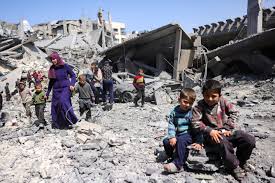
Eyewitnesses report that explosions shook neighborhoods “like earthquakes,” with artillery shells raining down overnight. Many families fled north or into makeshift camps in search of safety—only to find none.
“There is no safe place anywhere in the Gaza Strip,” said Hamdi Abu Mughseeb, a 50-year-old displaced resident. “We don’t know where to go anymore.”
WHO, UN Warn of Catastrophic Breakdown in Humanitarian Services
The UN reports that at least 875 Palestinians have been killed while seeking food since May, when Israel relaxed its blockade to allow limited aid through non-UN channels. Children and adults alike are now dying of malnutrition and dehydration, particularly in southern and central Gaza.
“The humanitarian conditions are breaking down at an accelerating pace,” said UN Secretary-General António Guterres, via spokesperson.
The UK-based Medical Aid for Palestinians described the crisis in Deir el-Balah as “extremely critical,” with shelling around their field office. WHO warehouses, hospitals, and ambulance services have all reported significant disruptions due to Israeli bombardments.
Hostage Families Demand Clarity Amid Expanding Offensive
The expansion of Israel’s military operations has also drawn criticism from Israeli families of hostages held by Hamas since October 2023. The Hostages and Missing Families Forum released a statement expressing deep concern over the risks posed to the remaining 49 captives, including 27 confirmed dead.
“Why is the military launching this offensive if it endangers the hostages’ lives?” the families asked in a press release.
So far, Israeli military spokespeople have not addressed concerns regarding the offensive’s impact on ongoing hostage negotiations.
Casualties Mount: Over 59,000 Palestinians Killed
As of July 22, 59,029 Palestinians—mostly civilians—have been killed, according to the Gaza health ministry. This number includes at least 15 people killed on Monday alone, as reported by Gaza’s civil defense agency.
AFP journalists captured images of black smoke billowing from airstrikes and tank shelling in Deir el-Balah. Civilians called emergency hotlines from under rubble or from homes surrounded by tanks, according to local rescue crews.
Due to strict media restrictions and access challenges, independent verification of casualty numbers remains difficult, but global agencies agree the toll is catastrophic.
Will International Outcry Lead to Action?
With more than 87% of Gaza’s territory effectively under Israeli control or evacuation, humanitarian agencies now warn of total collapse. The WHO’s direct targeting, combined with a united diplomatic front from the West, may mark a turning point in international tolerance for Israel’s war strategy.
So far, Israel has stood firm, justifying its actions as necessary to eradicate Hamas. However, the chorus of international voices—including traditional allies—calling for restraint, accountability, and a ceasefire is growing louder.