Trump Escalates Standoff with Russia: Nuclear Submarines Deployed Amid Rising Tensions Over Ukraine
In a dramatic and unprecedented escalation, U.S. President Donald Trump has ordered the deployment of two nuclear submarines closer to Russia, signaling a sharp turn in geopolitical tensions that began as a war of words and has now entered the perilous domain of nuclear posturing.
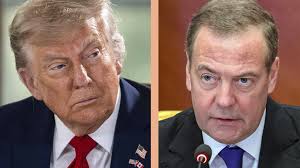
The move, announced on August 1, 2025, follows an increasingly volatile exchange between Trump and Dmitry Medvedev, the Deputy Chairman of Russia’s Security Council, over Ukraine, tariffs, and nuclear threats.
From Social Media Spat to Strategic Submarine Movements
Trump’s Online Warning Turns Tactical
What began as provocative exchanges on social media has now turned into a real-world military maneuver, with Trump taking to his Truth Social platform to declare:
“Based on the highly provocative statements, I have ordered two Nuclear Submarines to be positioned in the appropriate regions, just in case these foolish and inflammatory statements are more than just that.”
While Trump did not specify whether the submarines are nuclear-powered or nuclear-armed, or where exactly they were deployed, his remarks immediately ignited concern across diplomatic and defense communities.
Later in an interview with Newsmax, Trump elaborated:
“We always want to be ready. And so I have sent to the region two nuclear submarines… just want to make sure that his words are only words and nothing more.”
Russia’s Oreshnik Missile & the Belarus Factor
Putin’s Hypersonic Threat
Trump’s deployment order came just hours after Russian President Vladimir Putin made headlines with an announcement that Russia had begun mass-producing its hypersonic nuclear-capable Oreshnik missile.
Putin warned these missiles could be deployed to Belarus, a staunch Russian ally bordering Ukraine, by the end of 2025.
Putin stated alongside Belarusian President Alexander Lukashenko:
“We have chosen a place for future positions. Work is now underway to prepare these positions. We will close this issue by the end of the year.”
This announcement was widely seen as a direct provocation to both NATO and the United States—especially as tensions around Ukraine remain unresolved and increasingly volatile.
The Ongoing Ukraine Crisis — Sanctions, Deadlines & Bloodshed
Trump’s Sanctions Warning
Trump has set a deadline for Russia to end its invasion of Ukraine by next week, threatening “unspecified new sanctions” if progress is not made. However, Russia appears unmoved.
In recent weeks, Russian attacks have intensified, with July marking a record number of drone strikes on Ukrainian territory. On Thursday, a combined missile and drone assault on Kyiv killed 31 civilians, including five children, devastating a nine-storey apartment block.
Russia’s Demands Remain Unchanged
Despite global calls for a ceasefire, Putin reiterated that Russia’s demands for peace remain firm, insisting Ukraine must:
-
Relinquish disputed territories.
-
Abandon its ambition to join NATO.
These demands remain non-starters for both Ukraine and its Western allies.
Nuclear Rhetoric and the Dead Hand Threat
Medvedev’s Dark Reminder
Medvedev, a former Russian president and now an outspoken Kremlin hardliner, inflamed the situation further by referencing Russia’s “Dead Hand” system—an automated Cold War-era mechanism designed to launch nuclear retaliation even in the absence of human command.
He posted on Telegram mocking Trump’s threats and hinting at Russia’s “formidable deterrence.”
In response, Trump hit back harshly, calling Medvedev:
“The failed former President of Russia, who thinks he’s still President… He’s entering very dangerous territory!”
Trump: “When You Say ‘Nuclear,’ My Eyes Light Up”
Speaking candidly in his Newsmax interview, Trump acknowledged that Medvedev’s nuclear references triggered his decision:
“When you mention the word ‘nuclear’… my eyes light up. And I say, we better be careful, because it’s the ultimate threat.”
Trump’s reaction underscores his willingness to react forcefully to rhetorical threats—especially when nuclear terms are used by adversaries.
Strategic Submarines — Silent but Powerful Signals
The U.S. Nuclear Triad in Action
The United States Navy maintains a triad of nuclear deterrence: land-based ICBMs, strategic bombers, and nuclear submarines.
Submarines, such as the Virginia-class fast attack sub USS Minnesota, typically operate with stealth, and their exact deployment locations are classified. The deployment of two such vessels—presumed to be armed—sends a chilling signal to Moscow.
Trump’s decision to publicly mention the movement is itself unusual and strategically deliberate, likely meant to serve as psychological deterrence.
Political Theater or Precursor to Crisis?
A High-Risk Strategy
Critics warn that Trump’s brinkmanship could backfire, potentially drawing the U.S. into direct confrontation with Russia or raising miscalculation risks in volatile areas like the Black Sea or Baltic regions.
However, Trump’s defenders say this is simply “peace through strength” in action—leveraging power to avoid war.
Medvedev’s Role: Troll or Threat?
While Medvedev’s actual influence within Russia is limited—he’s often dismissed as a “Kremlin mouthpiece”—his online provocations often mirror the most aggressive strands of Russian policy, including threats of nuclear retaliation and territorial expansion.
His escalating rhetoric over Trump’s trade sanctions and Ukraine policies appears to have struck a nerve in Washington.
Civilian Toll Mounts as Diplomacy Stalls
Kyiv Mourns as World Watches
As global leaders trade threats, Ukrainian civilians continue to bear the brunt of a war now entering its fourth year.
Friday was declared a day of mourning in Kyiv, following the latest missile strike that left 31 dead. Ukrainian President Volodymyr Zelensky renewed calls for direct talks with Putin, stating:
“The United States has proposed this. Ukraine has supported it. What is needed is Russia’s readiness.”
There is no indication Moscow is willing to engage.
The Most Dangerous Game in Modern Politics?
Trump’s nuclear submarine deployment represents one of the boldest moves of his second presidency—an action that blurs the line between diplomacy and military brinkmanship.
Whether this leads to de-escalation, deterrence, or disaster will depend on what happens next between Washington, Moscow, and Kyiv.
One thing is certain: nuclear diplomacy is back on center stage—and the world is watching.