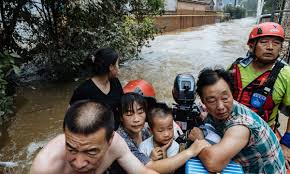
Over 30 Dead, 80,000 Evacuated in Wake of Record Rainfall
Northern China is facing a devastating humanitarian and infrastructural crisis after torrential rains triggered catastrophic flooding in regions surrounding Beijing. More than 30 lives have been lost, tens of thousands have been displaced, and critical infrastructure has been severely damaged as authorities scramble to respond to what residents are calling “a once-in-a-hundred-years” flood.
The worst-hit area includes the mountainous Miyun District on the outskirts of China’s capital, where over 80,000 people have been forced to evacuate, more than 100 villages have lost power, and entire communities are knee-deep in thick mud and debris.
On the Ground: Villages Gutted, Residents Stunned
Miyun’s Taishitun Town Bears the Brunt
In the town of Taishitun, about 100 kilometers northeast of Beijing’s city center, the aftermath of the flood has been described as apocalyptic. Locals were seen wading through sludge, digging through damaged homes, and retrieving scattered belongings from murky waters under the sweltering July sun.
“It’s the kind of flood seen once in a hundred years,” said Pang, a 52-year-old resident, pointing to a refrigerator swept 500 meters away by the rushing waters.
Floodwaters tossed vehicles like toys — a truck-mounted crane struggled to extract an SUV from a tangled pile of debris, while nearby streets were littered with ruined cars and crumpled office spaces blanketed in brown mud.
“We Didn’t Know What to Do”
Survival Stories from the Eye of the Storm
One local woman surnamed Zhao, also 52, recounted waking up early Monday to find her home flooded.
“The mud was this thick,” she said, raising her hand to mid-calf height. “My mother and I tried to shovel it out, but it was hopeless. We just picked up some clothes and ran for higher ground.”
Returning later, Zhao found her refrigerator, washing machine, and kitchen completely soaked and coated in sludge.
Further north, in Xinanzhuang village, AFP journalists witnessed homes, roads, and even parts of highways submerged in muddy floodwaters. A local man in his 60s simply said:
“I’ve never seen the water rise this high in my life.”
Xi Jinping Orders Maximum Preparedness
Chinese President Urges “Worst-Case Scenario” Planning
As the situation escalated, President Xi Jinping issued urgent instructions to national and regional authorities. He emphasized preparedness for worst-case scenarios and rapid relocation efforts for those in flood-threatened areas.
“We must not delay. People’s safety is paramount,” read a directive from Xi’s office.
With meteorologists warning that the rains could persist into Wednesday, the risk of further damage remains high — especially in mountainous regions where runoff can become deadly torrents.
Economic & Infrastructural Impact Looms
Power Cuts, Destroyed Roads, Supply Chains Threatened
Beyond the humanitarian cost, the economic fallout is mounting. Disrupted electricity across 100+ villages, damaged transportation arteries, and the destruction of personal and public property will likely take months to repair.
Several local supply chains — especially for agriculture, small-scale manufacturing, and regional logistics — are now vulnerable. With Beijing so close to the epicenter, disruptions to the capital’s peripheral economy are being closely monitored.
Global Lessons from China’s Flood Crisis
Climate Volatility, Urbanization, and Policy Response
This flood highlights a pattern increasingly familiar to many regions across the globe: climate volatility meets unchecked urban development. China’s rapid urban expansion into flood-prone regions, combined with extreme weather patterns, has made areas like Miyun especially vulnerable.
Global CEOs and policymakers alike can draw several critical lessons from this catastrophe:
-
Disaster resilience must be a core pillar of urban planning
-
Climate-adaptive infrastructure (like flood barriers and early-warning systems) should be prioritized
-
Public-private coordination is essential in rapid response and recovery
What Comes Next?
Recovery Begins, But More Rain on the Horizon
With continued rain in the forecast, China’s disaster response forces remain on high alert. Evacuation efforts are expanding, while utility crews and local governments race to restore electricity, clear debris, and assess structural damage.
While recovery has just begun, China’s long-term response will serve as a litmus test for global disaster preparedness in a century increasingly defined by climate chaos.