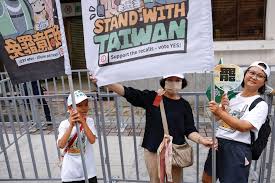
A Historic Political Reckoning That Could Reshape Taiwan’s Government
This Saturday, Taiwan is poised for a political shakeup unlike any in its recent democratic history. A massive recall election, targeting nearly a fifth of the island’s lawmakers — all from the opposition Kuomintang (KMT) — is unfolding in what analysts are calling a potential tipping point in the battle for legislative control and national sovereignty.
Civic groups, increasingly alarmed by what they see as pro-Beijing posturing by the KMT, have mobilized an unprecedented recall movement. The stakes are high: the outcome could either return full power to the ruling Democratic Progressive Party (DPP) or solidify a divided government heading into a tense era of cross-strait relations with China.
What Is a Recall Election in Taiwan?
Democratic Check — or Political Weapon?
In Taiwan, recall elections are a constitutionally enshrined tool allowing voters to remove sitting lawmakers. However, a recall can only be initiated after the legislator has served one year in office. For a recall proposal to advance, at least 10% of registered voters in a lawmaker’s district must sign a petition. These signatures must be officially verified by Taiwan’s election commission before a vote is triggered.
The current recalls represent the largest in Taiwan’s democratic history, with 24 KMT lawmakers facing votes on July 26 and seven more on August 23.
The Political Balance: A Fragile Legislative Chessboard
KMT Controls the Numbers — For Now
Although President Lai Ching-te of the DPP won the presidential election in 2024, his party lost its majority in the Legislative Yuan. The opposition KMT, backed by the smaller Taiwan People’s Party (TPP), holds a slim advantage in the 113-seat parliament with 62 seats, leaving the DPP with 51.
This opposition majority has significantly hampered the DPP’s agenda, blocking bills, slashing budgets, and freezing key spending — including funding for national defense amid rising threats from Beijing.
But the recall movement threatens to upend this balance. If enough KMT lawmakers are successfully removed, the DPP could temporarily regain a working majority, allowing it to push through blocked legislation and reset the national agenda — at least until required by-elections are held in the coming months.
What’s Driving the Recall Movement?
A Civic Uprising Against Beijing’s Influence
The recalls were not launched by the DPP itself, but rather by independent civic groups concerned about what they describe as the KMT’s increasingly pro-China behavior.
According to these groups, the KMT has:
-
Undermined Taiwan’s sovereignty by cozying up to Beijing
-
Slashed defense budgets even as China ramps up military pressure
-
Blocked or delayed legislation critical to national security
-
Pushed to expand parliamentary powers in ways that weaken executive leadership
Framing the recalls as a “democratic pushback” and even an “anti-communist” movement, activists claim the KMT is serving China’s interests rather than Taiwan’s — a serious accusation in a country whose democracy is often threatened by Beijing’s influence campaigns.
While the KMT denies these allegations, many of its lawmakers regularly visit China, and the party has long maintained a more China-friendly posture, advocating for dialogue and economic engagement across the Taiwan Strait.
KMT: “This Is a Malicious Power Grab”
Opposition Party Hits Back, Cries Foul
The KMT has gone on the offensive, describing the recall drive as a “malicious political maneuver” orchestrated by pro-DPP forces under the guise of civic action. The party argues that its lawmakers are merely fulfilling their constitutional role by scrutinizing government waste, advocating for fiscal responsibility, and pushing back on overreach by the executive branch.
In a bid to mobilize its base, the KMT has launched a counter-campaign urging voters to vote “no” and resist what it portrays as an attempt by the DPP to seize full control over the government — including the presidency, parliament, and key budgetary levers.
“This is not about governance. It’s about dictatorship,” claimed one senior KMT figure on the campaign trail. “Taiwan’s voters already made their choice last year. This is an effort to undo that outcome.”
Who’s on the Chopping Block?
Vulnerable Lawmakers and Safe Seats
Although petitions were launched to recall members of both the KMT and DPP, only the KMT recalls met the signature threshold to proceed. In total, 31 KMT lawmakers will face votes — with 24 up for recall this Saturday and 7 more on August 23.
Even if several are recalled, some analysts believe the KMT could easily reclaim those seats in subsequent by-elections, especially in safe constituencies where party loyalty runs deep.
Still, the short-term implications could be seismic. Even a temporary shift in parliamentary control could allow the DPP to:
-
Push through legislation currently blocked by the opposition
-
Reverse budget cuts, especially in defense and social programs
-
Reclaim narrative control in the ongoing China debate
What Role Is the President Playing?
Lai Walks a Fine Line
Though the recalls were not initiated by the ruling party, President Lai Ching-te has expressed cautious support for the movement. While avoiding direct campaign appearances, Lai has encouraged DPP lawmakers and supporters to back the recalls.
He emphasized the role of civic action in strengthening democracy but has stopped short of making the issue a central plank of his administration.
Meanwhile, senior DPP officials have been highly visible on the ground, campaigning alongside civic organizers and arguing that a successful recall is crucial to defending Taiwan’s independence and democratic integrity.
Will the Recalls Succeed?
Turnout Is Key
For a recall to pass, it must meet two thresholds:
-
A majority “yes” vote among ballots cast
-
The number of “yes” votes must exceed 25% of all registered voters in the constituency
This makes voter turnout a critical factor. In low-turnout districts, even a vocal minority could swing the result. Conversely, high turnout could dilute the impact of highly motivated recall supporters.
Observers say this election will test the mobilization strength of both sides, especially in politically divided regions.
The Bigger Picture: A Battle for Taiwan’s Future
Democracy, Sovereignty, and the China Question
At its core, this recall election is about more than just numbers in the Legislative Yuan. It reflects a growing ideological rift in Taiwanese society — between those who advocate for closer ties with Beijing in the name of peace and prosperity, and those who believe that Taiwan’s independence and democratic values must be vigorously defended.
As China continues to exert pressure on Taiwan — through military drills, disinformation campaigns, and diplomatic isolation — the island’s internal politics are becoming a frontline in the broader regional struggle between authoritarianism and democracy.
The recalls are the latest chapter in that story — and possibly the most consequential.
Taiwan at a Crossroads
Saturday’s recall vote is more than a referendum on individual lawmakers. It is a national litmus test on Taiwan’s identity, governance, and geopolitical stance. Whether the DPP gains ground or the KMT holds firm, the outcome will shape Taiwan’s domestic and foreign policy for months — if not years — to come.


