Bobby Kertanegara and the Price of Power
Prabowo’s Presidential Cat Escorted by Police, Dividing a Nation Over Public Spending
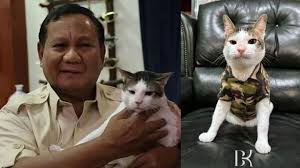
In a week dominated by debates on governance and fiscal responsibility, Indonesia’s political discourse was unexpectedly hijacked by a tabby cat. Not just any feline, though — Bobby Kertanegara, President Prabowo Subianto’s long-time pet, has officially become the country’s “first cat.” The cat not only commands over a million Instagram followers but also receives full state protection, including a police escort at public events.
While some Indonesians see Bobby as a symbol of warmth and compassion in politics, others are fuming. The heart of the controversy? State resources — funded by taxpayers — are being used to provide security for the president’s pet.
The Viral Moment: Police Escort for a Presidential Pet
It all began last weekend when Bobby Kertanegara made a public appearance at Jakarta’s Cat Lovers Social Day 2025. In a now-viral video, Bobby was seen being wheeled in a designer stroller, flanked by uniformed officers tasked with his protection. The video instantly sparked a firestorm online.
Critics questioned why police officers — whose salaries are funded by public taxes — were assigned to guard a pet. Social media platforms, particularly X (formerly Twitter), exploded with reactions. One user summarized the general sentiment:
“Pathetic. Getting paid with the sweat of the people just to escort a cat? Have we gone so astray as a nation?”
Government Response: “He’s Presidential Property”
In an attempt to quell the backlash, Deputy State Secretary Juri Ardiantoro defended the government’s actions. He argued that Bobby, as the property of the president, falls under official security protocols.
“It’s not just the president, but the president’s property is also the responsibility of the state,” Juri said, speaking to Tempo.
“Now I want to ask, who does Bobby belong to? Can the state guard him? Of course, it can. Why should there be a protest?”
While the response was legalistic and matter-of-fact, it did little to calm public outrage. Critics accuse the government of being tone-deaf at a time when economic pressures are mounting on ordinary Indonesians.
Bobby’s Backstory: From Stray to Social Media Star
Bobby wasn’t always a presidential figure. Adopted by Prabowo Subianto nine years ago, Bobby’s story is one of transformation — from stray to household name. With more than one million followers on Instagram, Bobby Kertanegara is no stranger to the limelight.
He’s met foreign dignitaries, including Australian Prime Minister Anthony Albanese, who even gifted him a scarf during a state visit — a moment that symbolized Bobby’s growing soft power.
To his fans, Bobby is more than just a cat. He’s become a cultural icon, representing Prabowo’s softer side — a contrast to the strongman persona he’s cultivated in politics.
The Opposition Speaks: “Personal Cult or Public Accountability?”
But not everyone is smitten by Bobby’s rise to fame. Political analyst Made Supriatma didn’t mince words in his critique of the situation.
“The use of public funds on Bobby is totally unjustified,” he told Tempo.
“Unless we want to treat cats as citizens… we are truly in a personal cult system, where the president’s cat and the president are treated the same way.”
His comments underscore a deeper concern: that Indonesia is slipping into a personality-driven political culture, where the lines between public office and personal interest blur dangerously.
Divided Public: Symbol of Joy or Symbol of Waste?
Public reaction to Bobby’s police escort reveals a nation deeply divided. While some see it as frivolous, others argue that Bobby serves a meaningful social function.
One X user defended the feline VIP, writing:
“It’s better to escort Bobby than to escort officials who are useless for the country. Bobby at least helps street cats and can make people smile.”
Supporters highlight Bobby’s role in raising awareness for animal welfare and offering a lighter, more humanizing aspect to national politics. They argue that the soft diplomacy he enables may be subtle but not without value.
What This Says About Indonesia’s Political Climate
This incident, though seemingly minor, reveals larger tensions in Indonesian society: public sensitivity to government spending, concerns over optics and priorities, and the growing skepticism toward political pageantry.
At a time when Indonesians are facing rising living costs, sluggish wage growth, and underfunded social programs, the optics of using state security to protect a cat — no matter how beloved — struck many as tone-deaf.
This isn’t just about Bobby. It’s about whether the government sees a clear boundary between personal affection and public accountability.
The Bottom Line: Leadership by Example?
If Prabowo’s administration wants to maintain credibility, it may need to reevaluate the messages it sends — even unintentionally — through such spectacles.
The broader question isn’t about whether Bobby deserves affection or even occasional PR moments. It’s whether taxpayer money should be used in the process. Leaders don’t just lead through policy — they also lead through example.
Bobby may be a cat. But in this moment, he’s also a mirror — reflecting the values, contradictions, and tensions of Indonesian governance in 2025.
Bobby Kertanegara’s rise from a rescued stray to the nation’s most famous pet is an undeniably heartwarming story. But when that narrative collides with state budgets and national priorities, it becomes political — whether intended or not.
Whether viewed as a charming mascot or a symbol of misplaced priorities, one thing is clear: Bobby has become more than a cat. He’s now a national conversation.